The Art is You
I watched an inspiring and hopeful talk from Brandon Sanderson about our art in the time of AI.
Brandon Sanderson is a fantasy fiction writer. He is doesn't like AI art.
Read his essay, The Hidden Cost of AI Art. Or watch it:
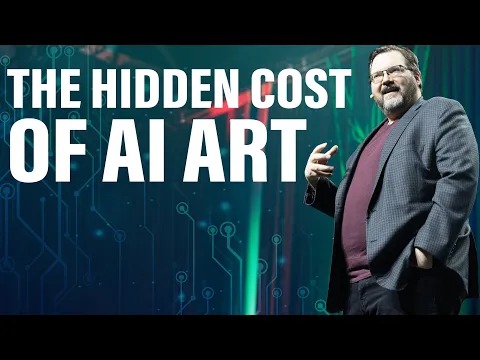
He acknowledges that there are many concerns about AI. But if you were to strip them all away, what would the base concern be? Using AI stops the development of people. People are missing in art. What we would see as artwork, then, would not be expressed by people.
I love this. We don't just care about products (outcomes outside of ourselves). We care about people (process and outcomes within people, including ourselves).
From his talk:
Art is the means by which we become what we want to be.
Creating is a process of yearning and becoming. What we create is a reflection of that process and the heights we attain. To remove me from the equation is to remove evidence of my life and its very meaning.
The process of creating art makes art of you.
If we let something else make the art, we have given away our opportunity for growth. We are lesser for it. We are less great than we could have been. More products (outside ourselves)? Possibly. Less of ourself (in products and within ourself)? By definition.
is a receipt.
The thing that you create is a reflection of what you've worked through and become. That's part of why we admire art. We can see the growth of others in artworks, and thus our own potential were we to apply ourselves.
Sanderson quotes Oscar Wilde who says:
All art is quite useless.
And:
We can forgive a man for making a useful thing as long as he does not admire it.
Can a company forgive a programmer who sees his programs as art and admires them? Will a company pay you a salary to "become what we want to be", if the machine can reliably receive commands and spit out the product they want?
Possibly yes, but quite possibly not.
This reminds me of the poignant post I read today from a programmer, Joe McKenney, "Competence as Tragedy", where he recounts a story by Corman McCarthy. In the story, "All the Pretty Horses", John Grady Cole has developed a great skill in working with horses, but in the end the world moves on from using horses to trucks, and it's unclear what this man of now-unappreciated skills means to the world.
If a machine, owned by a corporation, can do what a human used to do, some might choose to employ the machine rather than the human. This is more likely in the "utilitarian" arts (Wilde's "useful thing") vs. the "fine" arts. Though neither are immune, apparently.
But the people live on, elsewhere. Where the people were, the machines now sit. But as Sanderson said,
The machine cannot admire what it made.
There is something human in that. And we sense its value. Because we have experienced the satisfaction of creation.
Possibly, there are some people and companies, both in fine and utilitarian art, who agree, and who value admiration of people and the works they create. Who says that programming can't be art?
During the speech, Sanderson refers to Roger Ebert famously saying that video games can't be art. Well, years later, there are many who would disagree. So many, that one might say that he was wrong generally.
What will the prognosis for programming be? Or AI-generated schtuff? Time and people will decide.
We as society say it. We define , and we give it meaning.
Very true. We will choose, over time, whether we view programming as art, even useful art, and admire it and those who craft it.
We have to do say no to the machines. We must choose to do the hard work of creating and growing. We choose what victory looks like, what art is. The art is me.